
Leading Without the Title
Making your way to leadership roles means you have to start leading first. Leading others means you have to lead yourself first.

👋 Hey, I’m Milan. This is Organizing Automation, my newsletter on building state-of-the-art digital products and the organizations that deliver them.
Many colleagues I interact with want to move into leadership roles. After a few years improving their developer competencies and becoming more senior, they feel ready for the next step. But the opportunity can take a long time. One cause that I see often: the person waits to lead until they get the (tech lead) role, but the organization won’t give them the role until they start leading. This impasse can be very frustrating. Solving it requires a frank conversation about what leadership really is. Spoiler: it’s not the title.
The term leadership is loaded and means many things to different people, but it is often related to being “in charge”: making decisions, deciding what you and others around you do, and coordinating.
Personal Leadership
The foundation of leadership is personal leadership. If you want to take charge over the work of others, you need to be in charge of yourself. You need to understand who you are, what drives you, what you’re great at and also what you’re less good at. You need to be able to work with all this: make sure that you maximize your strengths, compensate for your weaknesses, and be all-round great at your job. This will make you a great example for those around you.
Getting better at this requires you to take a look at yourself. But while trusting your own judgment is normally good, you will be biased when the subject is you. Make sure to ask others to help you. What do they see that you’re good at, and where do they think you can improve? Getting feedback from teammates, your manager, and coaches or trainers can do wonders for your understanding of you. Use feedback from teammates that are senior to you, but also juniors. Take this feedback to heart and truly try to understand it. Only when you understand yourself can you truly take charge.
Wanting to lead is natural, but it can be useful to understand what your personal motivation is. It may be the challenge, the responsibility, the status or the money. There is no correct reason to want it, but your motivation can help you understand what the best way is to shape your ambitions.
My own motivation is that I like the challenge of specifying a big task and coordinating the work. With the help of a coach, I realized that in addition to this, I want to do my work well because that gives me self-esteem. The coach then worked with me on separating my self-esteem and professional achievements. Although this separation is not simple, it has helped me become a better leader. It may not be surprising, but personal leadership is deeply personal and can force you to confront some previously unknown parts of your psyche.
Personal leadership is a wonderful trait for everyone: taking responsibility for yourself and your obligations makes you more reliable, more impressive and more mature. Regardless of your experience level, you can (and should!) start exercising your personal leadership capabilities; they will benefit you. Your personal leadership journey will never be finished, but you’ll be able to see big differences after you’ve consciously worked on it for a while.
Leading without the Role
Assuming that you have personal leadership under control, you can start looking at leadership beyond yourself, which I’ll refer to as “leadership” from now on.
Leadership is not appropriate for everyone, everywhere. Especially in larger development teams, personal leadership may be all that is requested from you. Leading others requires a level of seniority - you do not need to be the oldest on the team, but you do need some experience under your belt to be able to guide the team. A developer with three months of experience likely won’t set the right course for the team. You need the experience, and the team needs to trust you.
This shouldn’t stop you from making a start. I have personally had good experiences with expressing to my team leads what my own ambitions are, and that I’d like to practice my leadership capabilities. This involved facilitating retrospectives, helping design activities, and joining discussions with stakeholders. This gave me an understanding of the leaders around me and the activities they worked on.
Pay attention to the organization around you, not just your own team. Having a better view of the whole playing field makes it easier to understand the context of the organization and understand why things are happening.
When you get the chance, explain things that you are knowledgeable about to others. Whether it is a junior that joins your team, a new technology that your team is looking at, or a show-and-tell within your organization, take the chance to talk to others about things you know. This forces you to present information in the right way to different groups, which is a key activity for leaders. Additionally, if done right, it cements your position as an expert, which increases trust in you and likelihood that people will accept you as a leader.
When I discussed becoming a senior consultant with my manager, I was told I should do something to showcase my expertise. I decided to take the internal conference and give a 50-minute talk there. I worked hard on it (and included contents from a lot of my early blogs). This showed the organization that I had something to say and made it more obvious that I was ready for the next step.
Leading with the Role
When you finally get the promotion and become the tech lead, you will realize that leadership with the role is actually the same as you were doing without. The same things remain important. The only guidance I have for this new situation is actually that you need to remember that nothing changes.
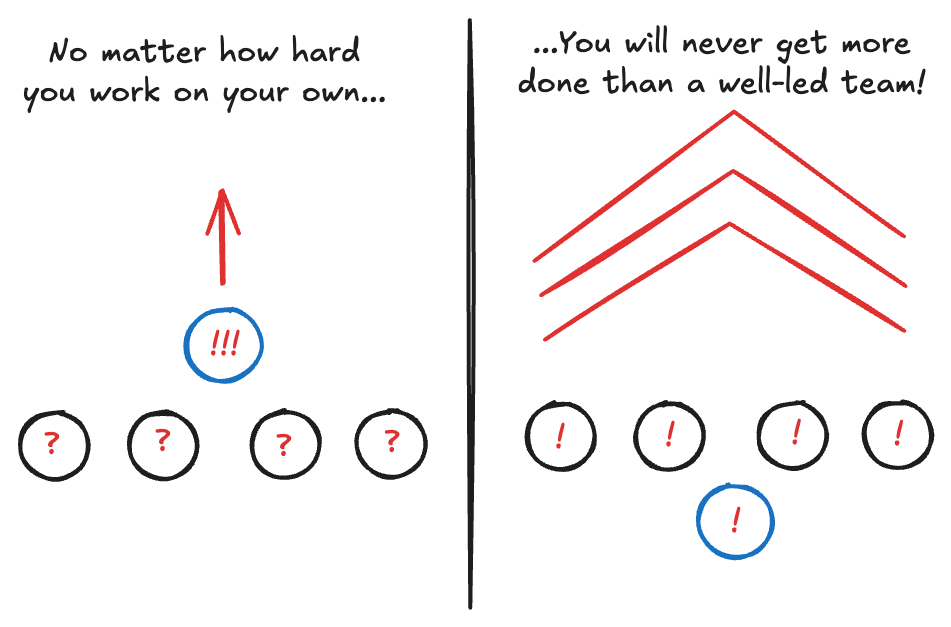
As the leader, you will be held accountable for the team’s performance. New leaders (myself included!) often make the mistake of working harder to compensate for anything going wrong. While you may be able to compensate for some problems by just working harder, there is a limit to what you can take. Additionally, working harder actually removes focus from what you should be working on, which is guiding your team to work in a way that achieves the set goals. Creating a hero culture is actually opposite of what a healthy leader does. You need to scale horizontally, not vertically.
Your job title is not a strong argument. If you make a decision that the team must live with, it is your obligation to explain what your considerations are and why you make the choice. Your title gives you some credibility, but if you cannot logically explain how you decide, you will not get real trust or commitment.
That being said, sometimes it is necessary to decide. If the team cannot figure it out democratically, you have to make a call. You may use your authority to make a decision, but know that you will also have to stand for it later. Make sure that you have always heard the arguments for and against. Using authority too often is risky for your trust, so trying to get concensus by using your explanation skills can be a better idea.
Although I’m further along in my journey, I still ask to collaborate with leaders that I want to see operate, as it teaches me a lot about what I’m doing. There’s always someone on the next step, and learning from them can be invaluable.
To conclude: leadership adds a whole new dimension of responsibility and complexity to your work. It has its upsides and its downsides. While not everyone can be top leadership, you can definitely start your leadership. Begin with yourself, get help, and slowly expand what you lead. Express that you want to lead and ask others what you’ll need to work on to do so.
What’s one way you can lead this week, without the title?
Recent Reads I Enjoyed
Inspired by Manager.dev, I’ll add some of the reads that I enjoyed recently to my blogs now and then.